Skip to content


The PUR foam layer should not be chosen on the principle of “as much as fits in the frame”. The required thickness depends on the product's λ value, the U-value target set for the whole structure, thermal bridges and how the insulated surface is used.
Three terms: λ, R and U
Thermal conductivity λ indicates how well a material conducts heat. The smaller the λ, the greater the thermal resistance at the same thickness. Thermal resistance R is calculated as the ratio of the material's thickness d to the λ-value: R = d / λ. The U-value indicates the thermal transmittance of the entire construction; the smaller the U, the more thermally insulating the construction.
The simplified 1/R calculation is suitable for comparing a single material layer, but does not show the exact U-value of a complete wall, roof or floor. The calculation for the entire structure takes into account all layers, surface resistances, framing and thermal bridges.
Calculated values for H2Foam Lite+
H2Foam Lite+ has a λ value of 0.036 W/(m·K). The figures below have been calculated based solely on the foam layer.
| Thickness | R, m²K/W | Simplified 1/R, W/(m²K) |
|---|---|---|
| 100 mm | 2,78 | 0,36 |
| 150 mm | 4,17 | 0,24 |
| 200 mm | 5,56 | 0,18 |
| 250 mm | 6,94 | 0,14 |
| 300 mm | 8,33 | 0,12 |
Heatlok Shield calculated values
The declared λ for Heatlok Shield is 0.027 W/(m·K). Due to the lower λ value, the same layer thickness provides
higher material-based thermal resistance than H2Foam Lite+.
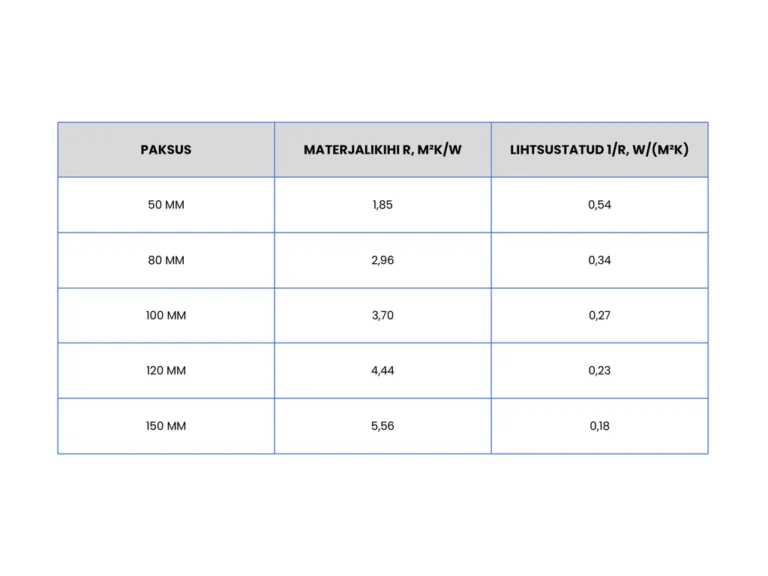
Important: The 1/R values in the tables are not the official U-value of the finished construction. They may be used for preliminary comparison, but they do not replace an energy efficiency calculation.
Why does the same layer thickness not give the same result in different structures?
- Timber posts and rafters form repetitive thermal bridges.
- A metal frame can significantly increase heat loss.
- The connection points of the roof, wall and plinth may be weaker in terms of calculations.
- Air leakages can increase actual energy consumption even with a material that has a good lambda value.
- A damp or damaged substrate impairs the performance of the structure.
- Internal and external surface thermal resistances and other construction layers affect the final U-value.
Typical thickness selection errors
- Only millimetres are compared, not the λ values of different products.
- The 1/R value of a single material layer is mistakenly used as the U-value of the entire wall.
- The thermal bridges of the frame are forgotten.
- Too thin a layer is chosen because the foam is airtight.
- Closed-cell foam is chosen solely because of the lower λ-value, even though the construction would require a more water-vapour-open solution.
- The layer thickness is decided before the finish, battening and penetrations have been clearly defined.
Does airtightness allow you to use less insulation?
Airtightness improves the actual performance of the structure, but does not replace thermal resistance. A 50 mm airtight layer does not provide the same thermal insulation as a 200 or 300 mm layer. The right solution combines a sufficient R-value and a continuous air barrier.
How to arrive at the right thickness?
- Determine the building part: roof, wall, floor, plinth or technical structure.
- Choose a technically suitable foam: H2Foam Lite+ or Heatlok Shield.
- Set the desired U-value for the whole structure.
- Calculate the thermal resistance of all layers and account for repeating thermal bridges.
- Check the hygrothermal performance.
- Adjust the layer thickness to the available space, finish and budget.
Related services: roof and loft insulation, wall insulation, foundation insulation, PUR foam price
→ PUR foam, wool or board: insulation materials compared